À LA UNE ! PLASTIC POLLUTION, BIODIVERSITY UNDER THREAT
Available in bookshops from 10 November 2026
Openbook (free) available to download from the publisher’s website (Quæ)
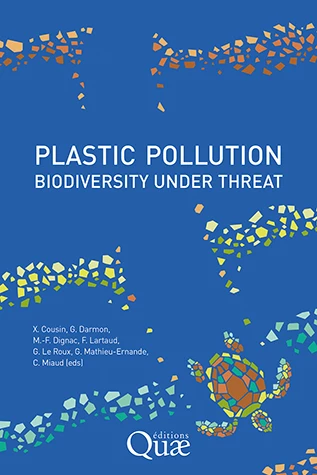
Plastics are everywhere, but what impact do they have on living organisms?
This is the subject explored in the collective work Plastic Pollution: Biodiversity Under Threat, coordinated by Biodivoc for Quæ Publishers, to which a group of 30 authors has contributed.
At every stage of their life cycle, plastics release debris, particles and molecules that contaminate terrestrial, aquatic and marine ecosystems. They thus contribute to the three major environmental crises: pollution, biodiversity loss and climate change.
No species is spared: from sea turtles to phytoplankton, from wheat to the European hedgehog, and including pike and grey herons, all are affected by this pollution, which is largely invisible as it consists mainly of micro- and nanoplastics, now present in every part of the environment.
The result of a collaborative effort involving several research organizations and universities, this book explores various aspects of this problem, which has now taken on a global dimension. It draws on the latest scientific advances, which have made it possible to better quantify and characterize this pollution and to study its impacts on biodiversity and the functioning of ecosystems—through biomonitoring, the study of sentinel species, research in ecotoxicology and other innovative approaches.
The authors also propose a regulatory framework, as well as solutions and alternatives for public policy-makers to address the challenges posed by this threat.
This book is aimed at decision-makers, researchers, and students of ecology, biology or environmental sciences, as well as members of the public keen to better understand the many forms that plastic pollution takes today and the challenges it raises.
Coordinators
Xavier Cousin studies the effects of exposure to various pollutants, including microplastics, on fish physiology and the resulting impacts on fish populations.
Gaëlle Darmon is a co-founder of WAO Nature & Conservation, which takes a scientific and collaborative approach to ecological transition and biodiversity. She works in particular with the Hisa (Human Initiative for Animals) association.
Marie-France Dignac’s research focuses on the impacts of microplastics on soil function and biodiversity.
Franck Lartaud, Deputy Director of the Banyuls Oceanographic Observatory, is a specialist in biomonitoring and the impacts of plastic pollution on engineer species.
Gaël Le Roux studies micropollutants, including microplastics, at the atmosphere-soil interface and their impacts on the functioning of the critical zone.
Gaëlle Mathieu-Ernande, regional coordinator for the BiodivOc Défi Clé initiative, is the general coordinator of this publication.
Claude Miaud has conducted research on the issue of marine debris, particularly the ingestion of microplastics by fish and sea turtles in the Mediterranean.
Where can I find the book?
You can order this book from your local bookshop, on the Quæ website or or using this form.
To cite this work:
Cousin X., Darmon G., Dignac M.-F., Lartaud F., Le Roux G., Mathieu-Ernande G., Miaud C. (eds), 2026. Plastic Pollution, biodiversity under threat, Versailles, éditions Quæ, 178 p., https://doi.org/10.35690/ 978-2-7592-4402-7